
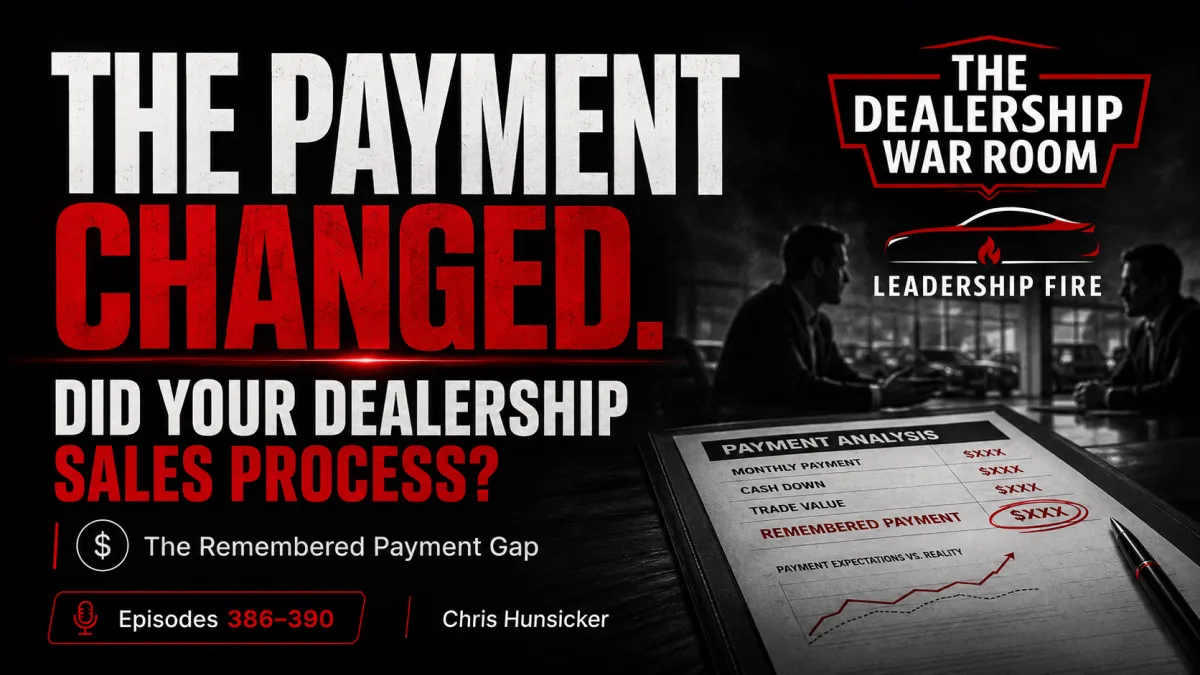
Your Customer Remembers a Payment That No Longer Exists
The Payment Changed. Did Your Leadership?
The customer looks at the payment.
Then at your salesperson.
Then back at the payment.
“I was at $449 three years ago. How did we get here?”
Nobody says anything for a second.
The salesperson feels the deal slipping.
The manager starts thinking about how to save it.
The customer starts wondering if somebody hid something.
And just like that, a financial conversation becomes a trust conversation.
Here’s the problem:
The payment moved.
The market moved.
The customer’s equity may have moved.
But your sales process may still be operating like none of it changed.
That’s where dealership leaders need to pay attention.
Because the market can change the number.
But your team determines what happens next.
The Customer Isn’t Comparing You to Another Dealership
Sometimes they’re comparing you to the life they remember.
The payment they had before.
The lease they had before.
The amount of cash they used to keep in their pocket.
The vehicle they could afford three years ago.
The expectation they carried into the showroom before anybody asked the first question.
Chris Hunsicker calls this the Remembered Payment Gap.
It’s the space between the number the customer remembers and the number today’s deal can actually produce.
And that gap can get emotional fast.
Not because customers are unreasonable.
Because money represents more than money.
A payment can represent:
room in the household budget,
freedom to replace a vehicle sooner,
cash available for other responsibilities,
staying inside a company allowance,
or simply feeling like they’re still in control.
That’s why the first mistake is treating payment shock like nothing more than an objection.
Because the customer may not really be saying:
“Convince me this payment is good.”
They may be asking:
“Help me understand what changed.”
That difference matters.
Chris breaks down the Remembered Payment Gap in Episode 386 of The Dealership War Room and shows why the conversation often goes wrong long before the pencil ever hits the desk.
The Fastest Way to Make It Worse?
Start defending the number.
You’ve seen this happen.
Customer:
“That’s way higher than I expected.”
Then everybody starts explaining.
Rates.
Incentives.
Trade value.
Terms.
The market.
The manufacturer.
The bank.
Everybody has an explanation.
Nobody has asked a better question.
And the longer the dealership explains, the more the customer can feel like they’re being told why their concern is wrong.
That’s not leadership.
Chris’s reframe is simple:
Do not overcome the customer. Lead the customer.
That sounds obvious.
It isn’t.
Because under pressure, good salespeople and good managers often rush toward solutions.
Different vehicle.
More money down.
Longer term.
Another lender.
Discount.
Change the structure.
But solving too quickly creates another problem:
You may be solving the wrong thing.
The Payment Is the Number. The Need Is Underneath It.
Imagine a customer says:
“I need to be around $600.”
What happens next in your store?
Does someone immediately start rearranging the deal?
Or does somebody get curious?
Because there is a massive difference between:
“What payment do you want?”
and:
“Why does that number matter?”
The customer may care about monthly cash flow.
But maybe they care more about keeping cash in the bank.
Maybe they want warranty protection.
Maybe they do not want to finance a vehicle for seven years.
Maybe their company reimburses only up to a certain amount.
Maybe their real concern isn’t the payment at all.
That is where the conversation becomes interesting.
And useful.
Because once your team understands what the customer is actually trying to protect, they can stop throwing random solutions at the problem.
The payment is the number. The need is underneath it.
That idea becomes the foundation for Chris’s Expectation Reset in Episode 388.
And this is where I would encourage managers to actually watch the episode with their team rather than just grabbing a word track from an article.
Because the power isn’t in memorizing a sentence.
It’s understanding the sequence.
Chris walks through four moves:
Acknowledge.
Discover.
Rebuild.
Confirm.
Simple?
Yes.
Easy under pressure?
Not always.
That’s why it needs to be coached.
There Is Usually a Trust Moment
Here is one of the most important ideas from the entire week.
The payment itself may not be the moment you lose the customer.
It could be the sentence right after it.
Think about the difference between these two reactions:
“That payment doesn’t exist anymore.”
and a salesperson who first recognizes that the customer’s expectation and the current reality are far apart.
Same payment.
Very different experience.
One can make the customer feel foolish.
The other makes them feel understood.
Chris calls that the Trust Moment.
It’s the moment your team either lowers the temperature or raises it.
Sometimes it is a sentence.
Sometimes a facial expression.
Sometimes a salesperson interrupting.
Sometimes a manager arriving and immediately taking control.
Sometimes it is twenty minutes of silence while the customer wonders what is happening at the tower.
These small moments matter.
And most managers never coach them.
They coach the result.
“Did we sell it?”
“Why did they leave?”
“What was the gross?”
“What happened on the trade?”
Those numbers matter.
But if your only explanation for the lost deal is:
“Payment.”
You haven’t learned much.
Episode 389 goes deeper into the Trust Moment and shows how the market can create the pressure while the dealership process determines whether trust survives it.
Managers, Here’s the Bigger Problem
If every difficult payment conversation requires your strongest manager to jump in and save the deal…
you may have a hero problem.
Hero problems can look great for a while.
The manager closes.
The experienced salesperson handles the angry customer.
The best F&I person repairs the damaged expectation.
The store keeps moving.
Until the hero is gone.
Vacation.
Day off.
Promotion.
Burnout.
Different store.
Now what?
If the team cannot handle difficult moments without one person rescuing them, capability never spread.
Chris tackles this in Episode 390.
The manager’s job is not just to save today's deal.
The manager’s job is to build people who can lead tomorrow's conversation.
That requires a rhythm:
Prepare.
Observe.
Coach.
Measure.
Repeat.
We’re not going to unpack the entire field guide here.
That’s worth hearing Chris teach.
But ask yourself one question:
Does your manager usually coach the salesperson through the difficult moment—or replace them inside it?
There is a big difference.
One creates dependence.
The other creates capability.
Try This Before Your Next Sales Meeting
You don’t need a new training platform.
You don’t need a giant meeting.
You don’t need forty slides.
Pick one payment conversation from the last 30 days.
One that got uncomfortable.
One where the customer reacted hard.
One where the salesperson immediately needed a manager.
Then ask:
When did we first understand what the customer expected?
When did we prepare them for a different reality?
What happened at the Trust Moment?
That discussion alone may teach you more than simply labeling the deal:
“Lost on payment.”
Because “payment” is the outcome.
Leadership lives in what happened before it.
The Market Will Keep Moving
That is really what this entire five-part series is about.
Today it is payment pressure.
Tomorrow it will be something else.
Rates move.
Incentives move.
Inventory changes.
Technology changes.
Customer expectations change.
The stores that struggle will keep blaming the conditions.
The stores that grow stronger will keep improving how their people operate inside those conditions.
Because the market creates pressure.
Your behavior determines trust.
So here is the question worth taking back to your management team:
The number moved. Did your leadership?
If this made you think about even one deal differently, don’t stop with the article.
Chris goes deeper across Episodes 386–390 of The Dealership War Room—from the Remembered Payment Gap, to how to stop defending the number, to the full Expectation Reset, the Trust Moment, and finally the manager’s field guide for coaching the process.
Watch it here: Chris Hunsicker | The Dealership War Room
Watch the series with your management team.
Then bring one real deal into the room.
Not theory.
Not another meeting.
One deal.
One conversation.
One moment worth getting better at.
Then run the rep.


