

How Dealership Managers Build Habits That Actually Stick
How Dealership Managers Build Habits That Actually Stick
Your team probably knows the standard. The leadership challenge is making the behavior survive the real workday.
A service advisor knows the walk-around matters. A salesperson knows the CRM follow-up is not optional. A manager knows the morning huddle should end with clear owners, not vague encouragement.
Then the lane backs up. Two appointments arrive early. The DMS slows down. A customer wants the impossible. The behavior disappears.
Most managers see that gap and reach for the same tools: another reminder, another speech, another contest, another threat, another training session.
Here is the leadership truth: your team may not have a knowledge problem. You may have a habit-installation problem.
Episodes 351 through 355 of The Dealership War Room build one clear argument: a manager’s job is not simply to announce the right behavior. It is to create the conditions that help people adopt and repeat the habits, mindsets, and beliefs that produce the result.
That means less dependence on emotional intensity and more attention to design. What exactly must happen? What makes it difficult? What will trigger it? How small can the first rep be? What protects the behavior after a bad day? What recognition helps the person see progress?
Taken together, the five episodes create a practical five-move operating system:
1. Diagnose the behavior.
2. Shrink the first rep.
3. Anchor and track it.
4. Protect the chain.
5. Celebrate the process.
This is not soft leadership. It is empathy with accountability. You still hold the standard. You simply stop pretending that repeating the standard is the same as building the behavior.
Want to hear Chris break down each step? Watch Episodes 351–355 and subscribe to The Dealership War Room on YouTube.
Watch it here: Chris Hunsicker | The Dealership War Room
Move 1: Diagnose the Behavior Instead of Blaming the Person
Episode 351 starts with a difficult reframe: the manager’s real competition is often not the dealership down the street. It is the comfort zone of the person sitting across from you.
That does not excuse poor performance. It changes the manager’s first question. Instead of asking, “What is wrong with this person?” ask, “What is missing from the behavior design?”
BJ Fogg’s Behavior Model gives managers a useful diagnostic: behavior happens when motivation, ability, and a prompt converge at the same moment. When the behavior does not happen, at least one of those elements is missing.
Use that lens on a service walk-around:
·Motivation: Does the advisor connect the walk-around to a result that matters personally, such as customer trust, stronger recommendations, or income?
·Ability: Can the advisor perform it confidently when three vehicles arrive at once? Is the process too long, awkward, or unclear?
·Prompt: What in the normal workflow tells the advisor, at the correct moment, to leave the screen and walk to the vehicle?
A manager who assumes every miss is a motivation problem will keep giving speeches. A manager who diagnoses the system may discover the real barrier: the tablet is never ready, the expected walk-around is too complex, the advisor lacks a simple opening line, or nothing in the RO process triggers the action.
Do not coach a vague outcome. Name one visible behavior.
“Improve customer pay” is not a behavior. “Walk the first customer of the day to the vehicle and point out one visible condition” is.
The more specific the behavior, the easier it is to coach, observe, track, protect, and reinforce.
Move 2: Make the First Rep Smaller Than Your Ambition
The finished process is rarely the right starting point.
Managers see the complete standard and try to install all of it at once: a full walk-around on every vehicle, photos on every multipoint inspection, a declined-service follow-up within 48 hours, complete morning preparation, and perfect documentation.
The team nods on Monday. The system is gone by Wednesday.
Episode 352 attacks the size of the ask. If a person has skipped the walk-around for six months, “every customer, every time” may be the destination, but it is a poor first step.
Start with a rep that feels almost too small:
·One customer per day.
·Walk to the vehicle.
·Point out one visible item.
·Ask one useful question.
Tiny does not mean lowering the standard. It means reducing the activation energy required to begin.
The first rep should be easy enough to execute on a hard day, not only on the day after training. Once the advisor experiences a better customer conversation, the behavior begins producing its own evidence. The manager is no longer selling a theory. The employee has felt the difference.
Use an anchor, not a floating intention
A behavior without a place in the workflow is a wish. Attach the new behavior to something the person already does.
·After I print the RO, I will invite the customer to the vehicle.
·After I finish the multipoint inspection, I will take one photo of the most urgent item.·After the last scheduled appointment, I will make one declined-service follow-up call.
·After the sales huddle, I will open the CRM and complete the first overdue task.
The anchor gives the behavior a home. It removes the need to remember it at some undefined point later.
Move 3: Anchor and Track the Daily Rep
Episode 353 shifts the manager’s attention from intensity to consistency.
One five-minute coaching conversation does not look transformational. Do it five days a week for 52 weeks and you create 1,300 minutes—more than 21 hours—of intentional development.
That is the compound effect of leadership. The daily act feels ordinary. The accumulated result does not.
The same principle applies to the employee’s habit. One follow-up call will not rescue the month. One walk-around will not transform customer pay. But the repetition changes skill, confidence, identity, and eventually results.
Make consistency visible
Use a simple tracker. Not a dashboard that takes longer to maintain than the behavior itself. A printed sheet, a tally card, or a checkmark on a personal checklist is enough.
The tracker has one job: make the chain visible. It should answer, “Did the rep happen today?”
·Walked one customer to the vehicle: yes or no.
·Made one declined-service call: yes or no.
·Completed morning preparation before the first appointment: yes or no.
·Delivered one specific recognition moment as a manager: yes or no.
Do not turn the tracker into surveillance. The employee should experience it as evidence of consistency, not as another report designed to catch failure.
Move 4: Protect the Habit After the Miss
Every new habit will collide with a bad day.
The DMS goes down. A comeback consumes the morning. The department is short-staffed. The first rep does not happen.
Episode 354 makes the next day the leadership moment. One miss is an event. Two misses can become a new pattern.
The manager’s response should be immediate, calm, and specific:
“I noticed the tracker did not get a mark yesterday. Bad days happen. Today, do it with your first customer before the day gets away from you. Can you do that?”
That conversation contains three elements:
1. I noticed.
2. The miss is recoverable.
3. The next rep has a specific time and trigger.
No shame. No lecture. No disappointed performance. Empathy does not remove accountability; it makes the recommitment easier to hear.
Protect known fundamentals with a short checklist
Checklists matter because capable people still miss known steps in complex environments. The World Health Organization’s surgical checklist is not evidence about dealerships, but it is a useful illustration of the principle: in the original multi-site study, major complications fell from 11% to 7%, and inpatient deaths fell from 1.5% to 0.8% after implementation.
The dealership lesson is not that a service lane is an operating room. It is that complexity makes fundamentals fragile.
Build a three-item checklist for the critical behaviors most likely to disappear under pressure:
·Morning preparation completed before the first customer.
·First walk-around completed with the first eligible customer.
·One declined-service follow-up completed before leaving.
Three items. Visible. Personal. Checked daily. That is habit infrastructure.
Move 5: Celebrate the Rep, Not Only the Result
Most dealership recognition arrives after the outcome: the record month, the CSI score, the gross target, the unit count.
Those wins deserve recognition. But outcome recognition comes too late to build the behavior that produced the outcome.
Episode 355 closes the arc with process recognition: catch the rep while it is happening.
“I saw you walk that customer to the vehicle. That is the third day in a row. Do you feel the difference in the conversation?”
BJ Fogg’s Tiny Habits method emphasizes positive emotion immediately after a behavior. The managerial version is not empty praise. It is accurate, specific recognition that helps the employee notice competence and progress.
Use a simple three-part structure:
1. See the behavior.
2. Say exactly what you noticed.
3. Ask the person what changed or how it felt.
That final question matters. The manager is not trying to become the employee’s permanent source of motivation. The manager is helping the employee see the evidence of who they are becoming.
Recognition should be close to the rep, tied to the process, and free of exaggeration. Do not wait until the end of the month to acknowledge the daily disciplines that created the month.
Five Management Mistakes That Kill New Habits
1. Installing the finished process on day one. The destination is not the starting behavior.
2. Treating every miss as a character issue. Diagnose motivation, ability, and prompt before assigning blame.
3. Tracking too much. A complicated dashboard becomes another abandoned habit.
4. Turning one miss into a confrontation. Correct fast without making the person defend the stumble.
5. Recognizing only outcomes. The result arrives after weeks of invisible reps; reinforce the reps while they are still fragile.
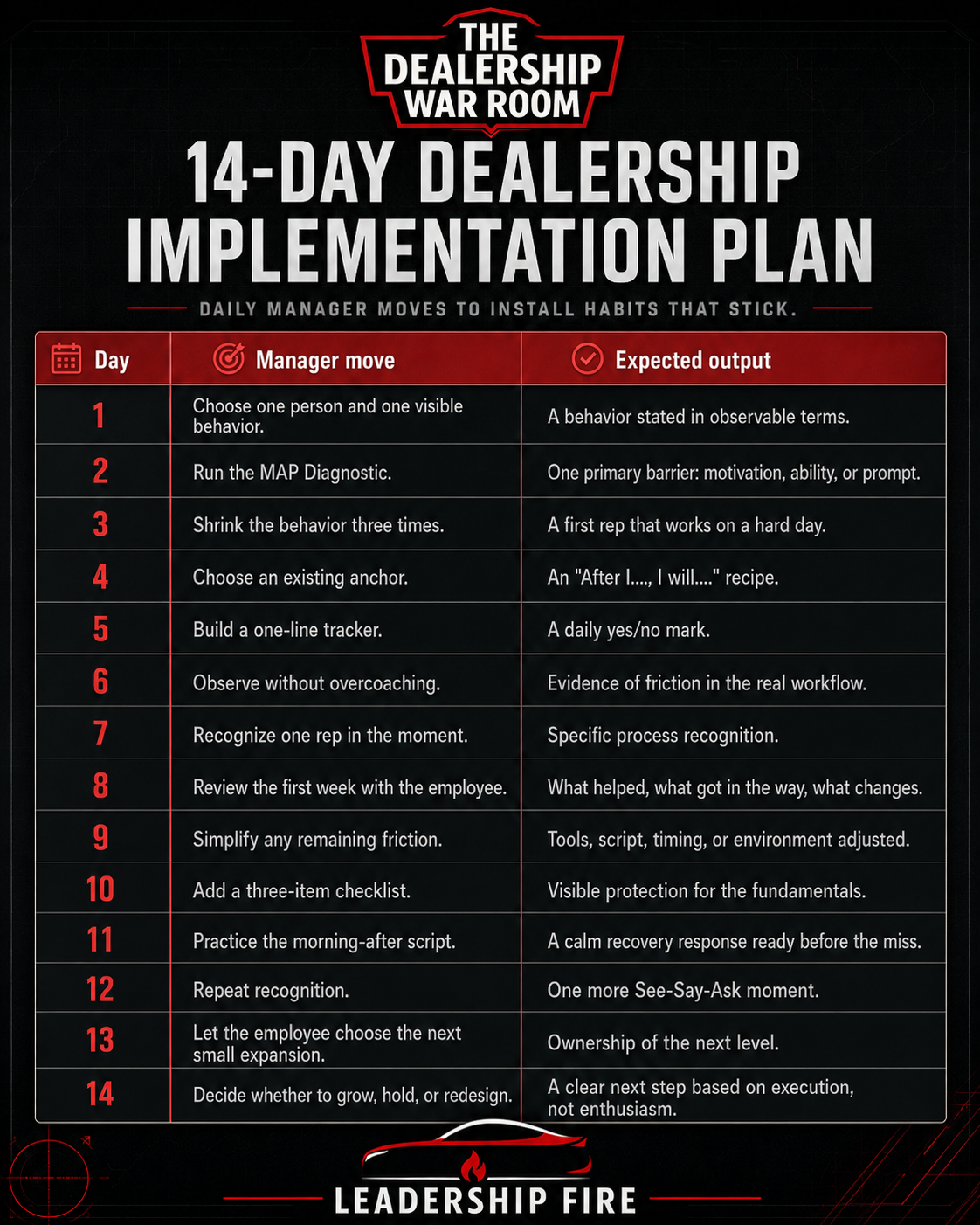
A 14-Day Dealership Implementation Plan
The Dealership Habit Installation Scorecard
Score each item from 0 to 2: 0 = no, 1 = partly, 2 = yes.
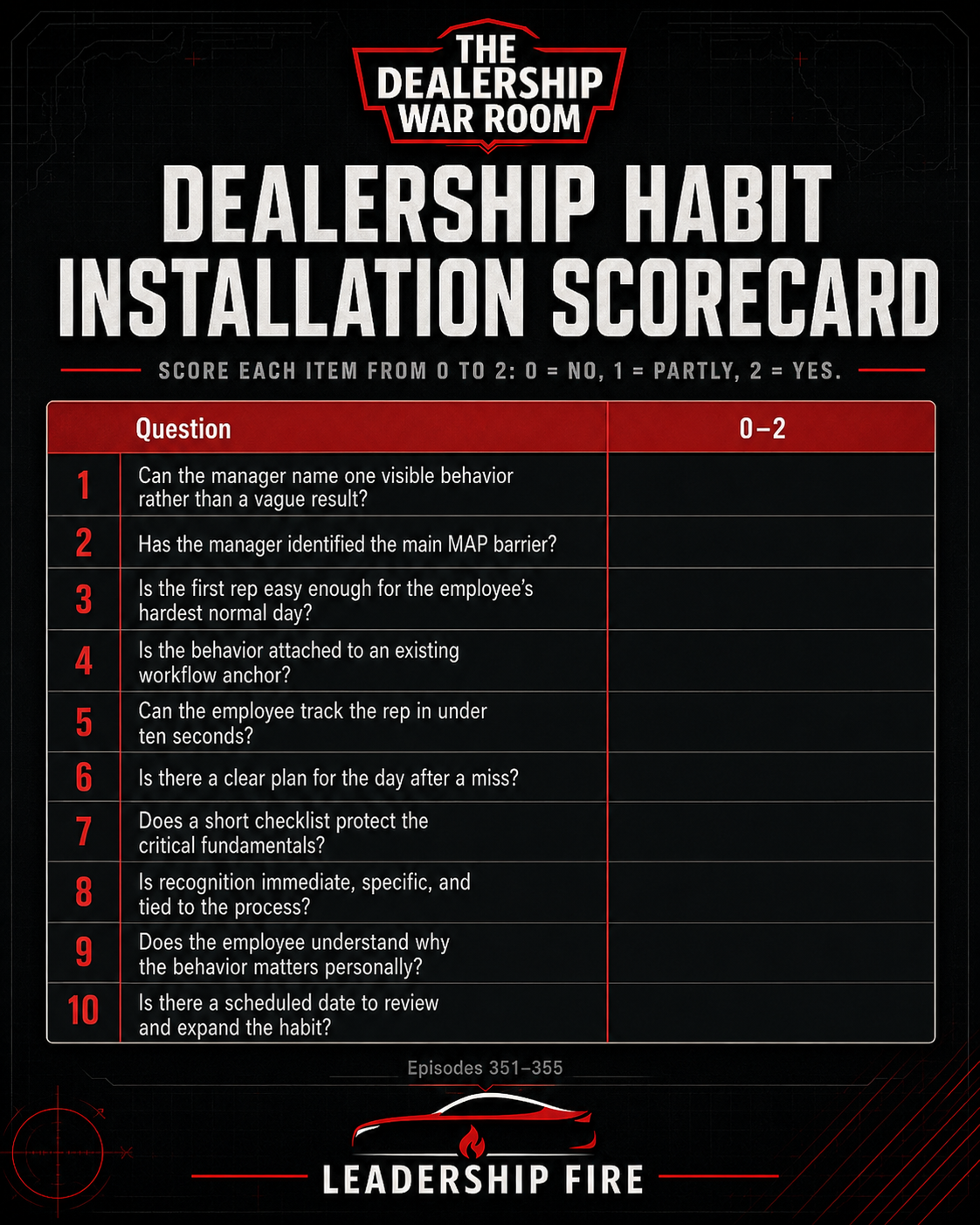
Interpretation: 0–7 means the behavior is being demanded but not designed. 8–14 means the system has pieces but remains fragile. 15–20 means the behavior has a practical path to consistency. These ranges are a managerial diagnostic, not a validated psychological assessment.
Frequently Asked Questions
Does starting tiny lower the standard?
No. It separates the entry behavior from the finished standard. You still define the destination. You simply create a first rep the employee can execute consistently enough to build skill and momentum.
What if the employee is not motivated?
Do not assume a speech will fix it. Clarify whether the person sees a personal reason to act, whether the behavior feels achievable, and whether the environment prompts it at the right moment. If motivation remains absent after a clear conversation, that becomes a separate fit and accountability issue.
How long should the tiny version stay in place?
Long enough to become reliable, not long enough to become a hiding place. Review after one or two weeks. Expand when the employee can perform the behavior without heavy prompting and can describe the value it creates.
Should the tracker be public?
Usually, personal and visible to the employee is enough. Public tracking can create energy for some teams and resistance for others. The purpose is self-evidence and coaching, not embarrassment.
What should a manager celebrate?
The behavior you want repeated: the walk-around, the call, the preparation, the clean handoff, the coaching conversation, the correct CRM step. Be specific. “Great job” is weaker than “I saw you slow down and walk the customer to the vehicle before opening the RO.”
Stop Managing the Gap. Start Designing the Rep.
Your people will not become consistent because the standard was announced with more force.
They become consistent when the behavior is clear, the first rep is small, the prompt lives inside the workflow, the progress is visible, the missed day is recovered quickly, and the manager notices the process before the result arrives.
That is the complete arc of Dealership War Room Episodes 351 through 355.
Diagnose it. Shrink it. Anchor it. Protect it. Celebrate the rep.
Pick one person. Pick one behavior. Build the system this week.
Then take the Dealership Leadership War Room Audit and identify where your store’s execution system is leaking.
Want to hear Chris break down each step? Watch Episodes 351–355 and subscribe to The Dealership War Room on YouTube.
Watch it here:Chris Hunsicker | The Dealership War Room


