
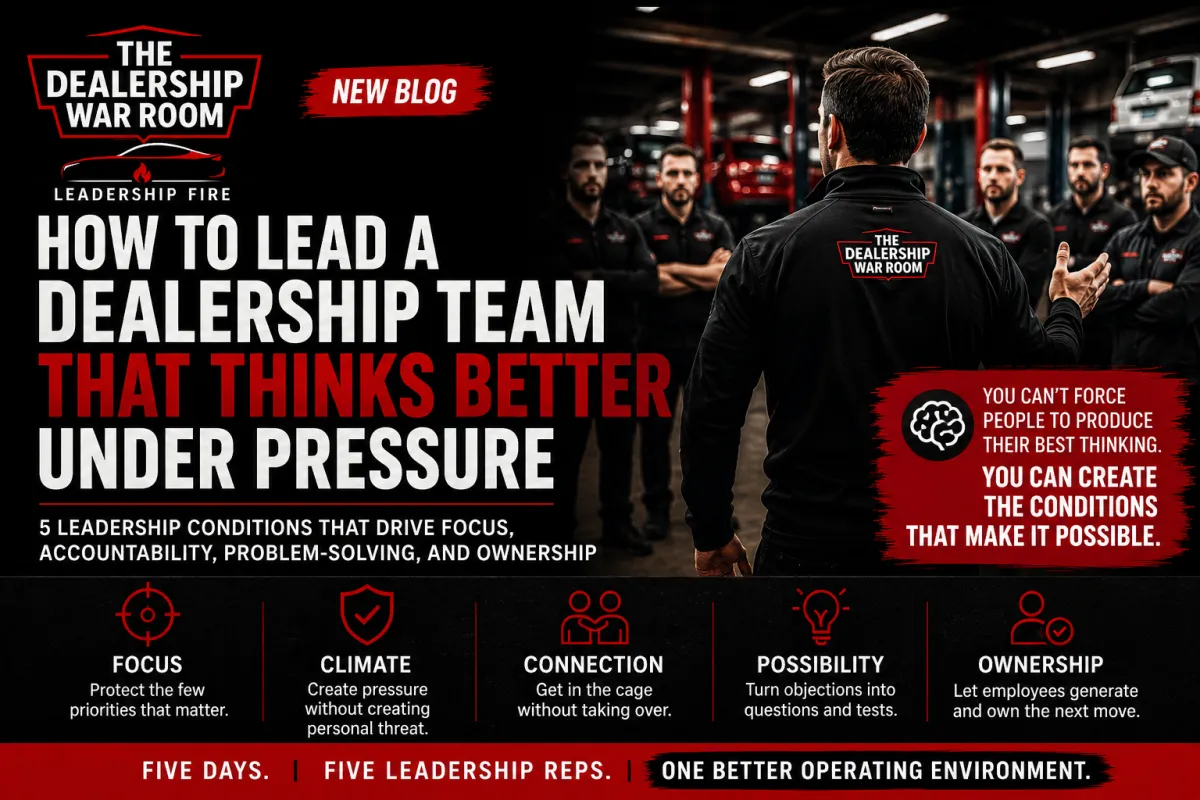
How to Lead a Dealership Team Under Pressure
How to Lead a Dealership Team That Thinks Better Under Pressure
You have talented people in your dealership.
They know the product. They understand the process. They have enough experience to recognize what a strong day should look like.
And yet, under pressure, the wheels still come off.
An advisor gets overwhelmed and stops working the opportunities already sitting in the service lane.
A salesperson spends the day reacting to fresh leads while yesterday’s follow-up dies inside the CRM.
A department head walks into the KPI meeting prepared to explain the market instead of explaining the plan.
One negative voice shoots down every new idea before the team has even tested it.
Then everyone brings the problem to the manager and waits for an answer.
It is easy to label this as an effort problem.
It may be a leadership-condition problem.
Across Dealership War Room Episodes 366 through 370, Chris Hunsicker examines five principles from Dr. Henry Cloud’s Boundaries for Leaders. Cloud’s official description of the book makes the central idea clear: leaders establish conditions that influence whether people can perform at a high level.
That leads to a direct leadership truth:
You cannot force your people to produce their best thinking. You can create the conditions that make their best thinking more likely.
For a dealership team, those conditions are focus, a productive emotional climate, connection, possibility, and ownership.
1. Focus the Team on What Matters Most
Every person in your dealership is paying attention to something.
The question is whether they are paying attention to the right thing.
When a team receives twenty priorities, it does not have twenty priorities. It has noise.
The phone rings. A customer escalates. A used-car appraisal arrives. Three employees need an approval. The manufacturer sends another message. Someone walks into the office and announces a problem that suddenly feels more important than everything else.
The team defaults to what is loudest.
Not necessarily what matters most.
That is why Chris opens the weekly series with Dr. Cloud’s principle of Executable Attention:
Attend to what matters.
Inhibit what does not.
Keep the priority in working memory.
Most managers handle only the first step. They announce the priority during Monday’s meeting and assume the team will carry it through the week.
By Wednesday, the priority is buried beneath normal dealership chaos.
Put the Focus Three in front of the team
Ask this question:
What are the one, two, or three behaviors that would move this department most right now?
For a service team, the Focus Three might be:
Complete a consistent walk-around on every eligible vehicle.
Present every maintenance recommendation clearly.
Complete declined-service follow-up before the end of the day.
For a sales team:
Respond to every fresh lead within the agreed standard.
Complete the day’s assigned follow-up before leaving.
Conduct the defined vehicle presentation and write-up process.
Do not bury those behaviors inside a 40-line checklist.
Keep them visible.
Coach them.
Measure them.
Talk about them every day.
Use the morning huddle to protect attention
A useful 15-minute huddle does not become another speech from the manager.
It creates a daily command post:
One useful tip.
One win and the behavior that produced it.
One challenge the team can help solve.
The day’s most important commitments.
The purpose is not to make everyone feel busy at 8:00 a.m.
The purpose is to prevent the dealership from spending its entire day reacting.
When everything is important, nothing is.
The leader’s job is to narrow the field.
2. Keep the Standards High and the Climate Productive
Some dealership leaders hear “positive emotional climate” and immediately translate it into low standards, soft conversations, or protection from consequences.
That is not the principle.
A productive climate does not hide reality.
It helps people face reality without turning every correction into a personal threat.
There is a major difference between these two messages:
“We missed the appointment target. We need to understand why and change today’s behavior.”
and:
“You people never get this right. I’m tired of carrying this department.”
The first message identifies a real performance gap.
The second makes the employee defend their worth, competence, or safety inside the group.
When employees feel attacked, embarrassed, or chronically threatened, the quality of their thinking can deteriorate. Research on stress and the prefrontal cortex has found that acute, uncontrollable stress can impair cognitive abilities associated with working memory, attention, and judgment.
That does not mean leaders should remove pressure.
Dealerships have targets. Customers have expectations. Missed follow-up has consequences. Poor inspections cost opportunities. Weak preparation shows up in the numbers.
Reality is still everyone’s boss.
The leadership challenge is to separate performance pressure from personal threat.
Run a climate audit
Before your next KPI review, ask:
What emotional state do I normally bring into this meeting?
Do I challenge the behavior or attack the person?
Do I correct people publicly when the conversation should happen privately?
Does my sarcasm create clarity or defensiveness?
Can people tell the truth in this room without being humiliated?
Am I filtering pressure or amplifying it?
A positive climate is not a consequence-free climate.
It is a climate where candor and accountability can actually work.
3. Get in the Cage
A manager can have high standards and still leave employees feeling like they are fighting alone.
That disconnection is expensive.
Consider an advisor who has missed the target for two weeks. Traffic has been uneven. Confidence is down. The advisor knows the numbers and can feel the pressure every time the manager walks through the lane.
The distant manager says:
“You know the target. Figure it out.”
The connected manager says:
“I see the gap. I know this stretch has been hard. I’m not lowering the standard, and I’m not leaving you alone in it. Let’s look at the next controllable move.”
Same standard.
Different leadership.
Connection does not remove the problem. It changes how the employee experiences the problem.
Research on social support and stress has found that supportive relationships can influence physiological stress responses, although the effects depend on the person, relationship, and context.
Inside a dealership, connection is built through repeated leadership behavior:
A one-on-one that happens before a crisis.
A floor walk that includes the people on the edge of the organization.
A manager who listens before diagnosing.
A coaching conversation that says, “We will work this, together.”
A leader who remains present after delivering difficult feedback.
Chris calls this getting “in the cage.”
You are not jumping into the cage to fight the employee’s battle for them.
You are making sure they know they are not fighting it alone.
Connection and accountability belong together
Connection without accountability becomes avoidance.
Accountability without connection becomes detachment.
Elite leadership requires both.
The employee should leave the conversation knowing:
My leader sees me.
My leader understands the reality.
The standard is still the standard.
I own the next action.
I will receive support and feedback while I execute it.
That is empathy with accountability—not one instead of the other.
4. Redirect Negative Thinking Toward Possibility
There may be someone on your team whose first response to every idea is a reason it will fail.
“We tried that before.”
“These customers will never go for it.”
“The market is too soft.”
“That process does not work here.”
Their experience may be real.
Their concerns may contain useful information.
But their thinking is also spreading.
One unchecked negative thinker can recalibrate the room’s sense of what is possible. Soon, the team stops asking, “How could we make this work?” and starts competing to explain why it cannot.
Arguing rarely fixes this.
Telling someone to “be more positive” does not give their mind anywhere useful to go.
Questions do.
When an employee says, “Declined-service follow-up does not work,” do not immediately deliver a five-minute rebuttal.
Ask:
What part of the current approach is failing?
Is there any positive opportunity hidden inside the problem?
If the process could work, what would have to be true?
What possibility have we not tested?
What is one experiment we could run this week?
What result would tell us whether the experiment worked?
Now the employee has to think.
Not defend.
Not surrender.
Think.
You are moving the conversation from a fixed conclusion to a testable possibility.
Do not confuse possibility with fantasy
Possibility-centered thinking does not mean pretending every idea is good.
It means refusing to reject an idea before the team has defined the conditions, risks, and smallest useful test.
Maybe customers are not responding to the current follow-up message.
That does not automatically mean follow-up is useless.
It may mean the timing is wrong. The message is generic. The advisor never established enough value. The team gives up after one attempt. Nobody tracks which services were declined or why.
A possibility question turns a complaint into an investigation.
That is how learning enters the dealership.
5. Give the Problem Back to the Person Who Owns It
Managers often create employee dependency while believing they are being helpful.
An employee brings a problem.
The manager sees the answer.
The manager explains the answer.
The employee nods.
Nothing changes.
A week later, the same employee returns with the same problem.
Why?
Because the manager did all the thinking.
Chris uses a deliberately sharp line in Episode 370:
The answer you give gets forgotten. The answer they discover gets done.
Treat that as a coaching principle, not an absolute law.
People sometimes need direct instruction. New employees need training. Compliance and safety issues may require a clear command. Emergencies are not the time for a Socratic seminar.
But when a capable employee brings a normal operating problem, the leader should resist the automatic rescue.
Try:
What do you think you should do?
What have you already tried?
What is the real problem underneath the problem?
What part of this situation can you control?
What options do you see?
Which option are you willing to own?
What will you do, and by when?
How will we know it worked?
Consider the advisor who says traffic is down and customers are not spending.
The advice response is:
“Call declined services. Follow up with sold customers. Work your maintenance opportunities.”
The ownership response is:
“Traffic is down. That is real. Given that reality, what opportunity do you have the most control over today?”
The advisor may reach the same conclusion.
But this time, it is their conclusion.
That creates a different level of commitment.
Leadership is not about controlling every person and every answer.
It is about creating enough structure, clarity, and coaching for people to control their next move.
The Five Leadership Mistakes That Shut Down Execution
These principles also reveal five common management mistakes:
1. Priority overload
The manager labels everything urgent and then criticizes the team for being unfocused.
2. Toxic pressure
The manager confuses embarrassment, intimidation, or volatility with accountability.
3. Detached leadership
The manager demands results while staying emotionally and operationally distant from the struggle.
4. Debating negativity
The manager fights every objection instead of using questions to turn objections into tests.
5. Advice addiction
The manager solves every problem and then wonders why nobody takes initiative.
None of these problems requires another motivational speech.
They require a leadership mechanism.
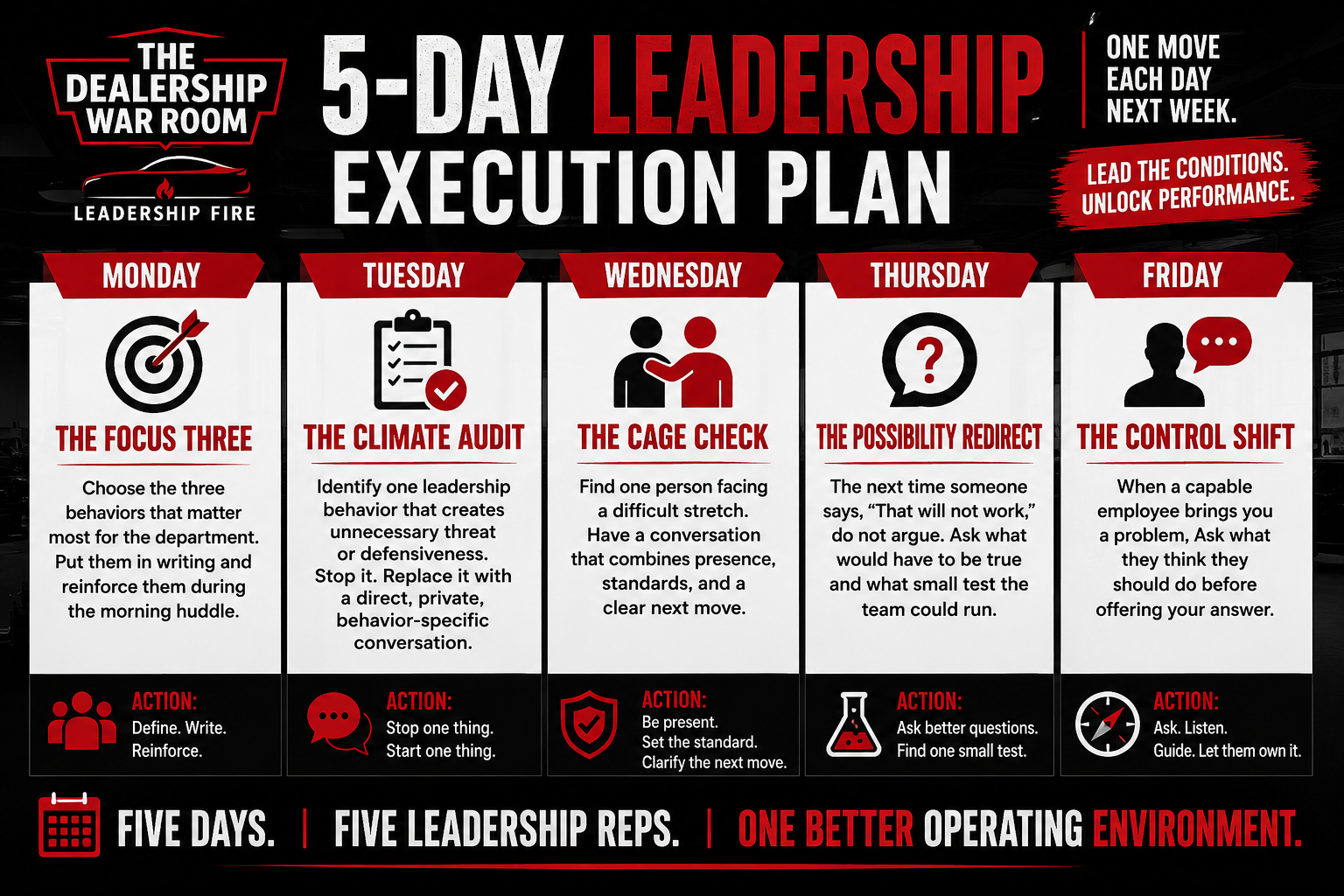
A Five-Day Dealership Implementation Plan
Use one move each day next week.
Monday: The Focus Three
Choose the three behaviors that matter most for the department. Put them in writing and reinforce them during the morning huddle.
Tuesday: The Climate Audit
Identify one leadership behavior that creates unnecessary threat or defensiveness. Stop it. Replace it with a direct, private, behavior-specific conversation.
Wednesday: The Cage Check
Find one person facing a difficult stretch. Have a conversation that combines presence, standards, and a clear next move.
Thursday: The Possibility Redirect
The next time someone says, “That will not work,” do not argue. Ask what would have to be true and what small test the team could run.
Friday: The Control Shift
When a capable employee brings you a problem, ask what they think they should do before offering your answer.
Five days.
Five leadership reps.
One better operating environment.
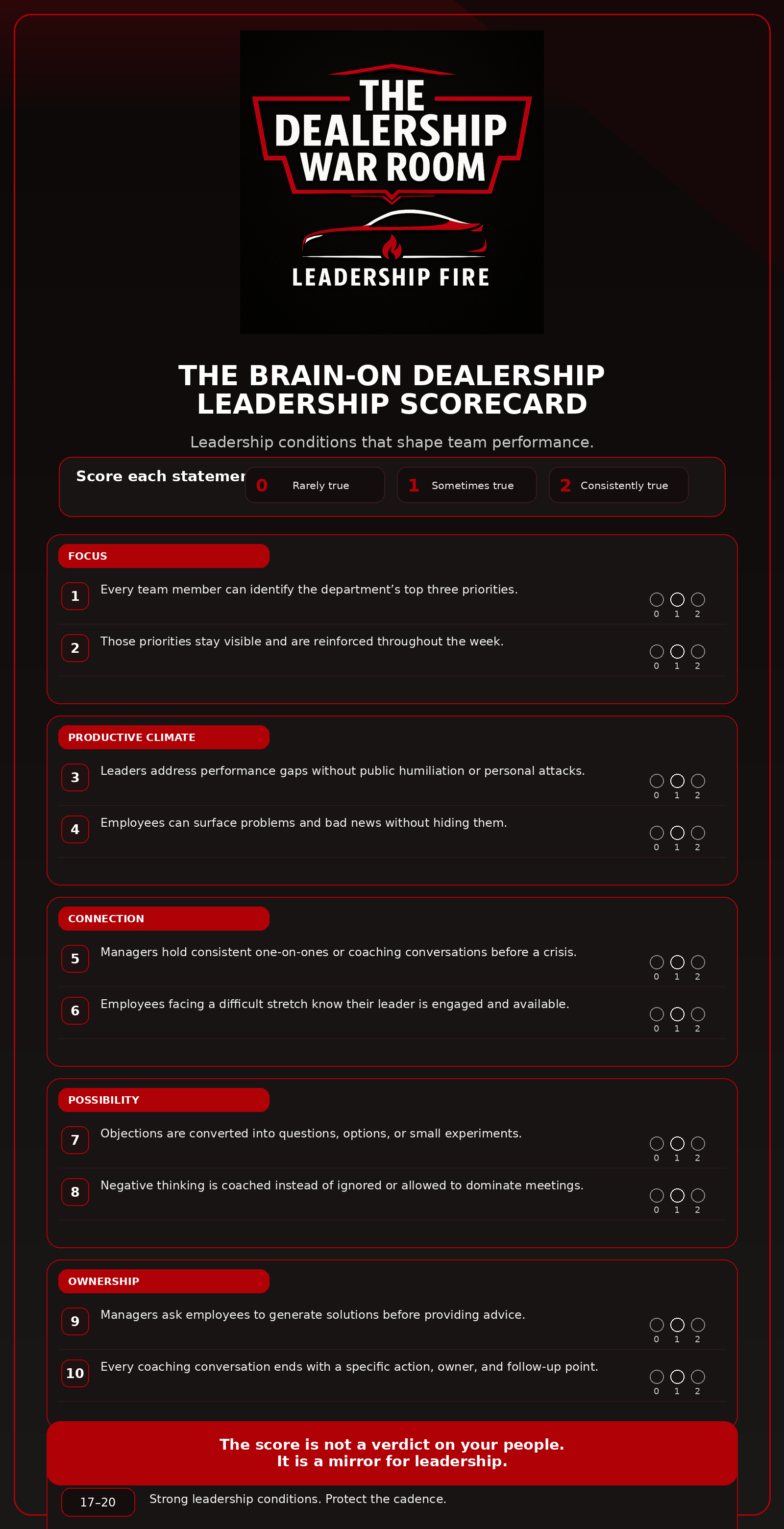
The Brain-On Dealership Leadership Scorecard
Score each statement:
0 — Rarely true
1 — Sometimes true
2 — Consistently true
Focus
Every team member can identify the department’s top three priorities.
Those priorities stay visible and are reinforced throughout the week.
Productive climate
Leaders address performance gaps without public humiliation or personal attacks.
Employees can surface problems and bad news without hiding them.
Connection
Managers hold consistent one-on-ones or coaching conversations before a crisis.
Employees facing a difficult stretch know their leader is engaged and available.
Possibility
Objections are converted into questions, options, or small experiments.
Negative thinking is coached instead of ignored or allowed to dominate meetings.
Ownership
Managers ask employees to generate solutions before providing advice.
Every coaching conversation ends with a specific action, owner, and follow-up point.
Score interpretation
17–20: Strong leadership conditions. Protect the cadence.
12–16: Inconsistent. Choose the lowest-scoring condition and install one mechanism.
7–11: The environment is likely producing avoidable dependency, noise, or defensiveness.
0–6: Stop asking why the team will not execute. Rebuild the leadership conditions first.
The score is not a verdict on your people.
It is a mirror for leadership.
Frequently Asked Questions
Does a positive emotional climate mean lowering dealership standards?
No. It means separating honest consequences and clear expectations from personal attacks, volatility, and humiliation. Reality remains the boss. The goal is to help people face reality with enough clarity to act.
What if an employee cannot answer a coaching question?
Narrow the field.
Ask what they have already tried, what they control, or which of two options appears stronger. Coaching is not abandoning the employee. It is helping them do more of the thinking.
What if the negative employee refuses to change?
Possibility questions are a coaching tool, not a substitute for accountability. If the behavior continues to damage meetings, undermine agreed processes, or influence the team, define the required behavior and the consequence of continued misalignment.
Should new employees receive questions or direct instruction?
Both. Teach the standard clearly first. Demonstrate it. Observe the employee. Then use questions to strengthen judgment and ownership as competence grows.
Can these principles work in both sales and fixed operations?
Yes. The operating examples change, but the leadership conditions remain useful. Sales may focus on CRM execution, appointments, presentations, and follow-up. Fixed operations may focus on walk-arounds, inspections, maintenance presentations, declined services, technician communication, and hours per repair order.
Your Team Does Not Need You to Think for Everyone
Your people need standards.
They need clarity.
They need feedback.
They need a leader willing to confront reality.
But they also need an environment where attention is protected, pressure is productive, connection is real, possibility remains open, and ownership is expected.
That is the deeper lesson behind Dealership War Room Episodes 366 through 370.
You cannot force a team to produce its best thinking.
You can build the conditions where better thinking becomes normal.
Start with the first condition.
Use the free AM Huddle Template in the FIRE Guides and Resources collection to narrow the day’s priorities, create public commitments, and replace walk-around firefighting with a clear daily cadence.
Want to hear Chris break down each step? Watch Episodes 366–370 and subscribe to The Dealership War Room on YouTube.
Watch it here: Chris Hunsicker | The Dealership War Room


