
How to Coach Employee Mindset in a Dealership
How to Coach Employee Mindset in a Dealership: 4 Real-Time Redirects
Consider four common hypothetical moments from a dealership week.
A service advisor skips the tire presentation and says, “I’m just not good at selling tires.”
A salesperson finishes a slow day and says, “The traffic was dead. What was I supposed to do?”
Another rep complains about a lead going to the person at the next desk.
Then your most experienced employee loses a customer, folds their arms, and tells you they already know why it happened before you finish your first sentence.
Four different moments.
One leadership problem.
You are looking at the behavior. They are operating from a mindset.
That distinction matters because behavior is downstream. You can retrain the process, review the KPI, restate the standard, and remind the team about the next inspection, walk-around, CRM task, or follow-up call. But when the belief underneath the behavior stays untouched, the same miss comes back wearing a different uniform.
Across Dealership War Room Episodes 356 through 360, Chris Hunsicker breaks that hidden layer into four practical distinctions:
Fixed versus growth
Victimhood versus ownership
Scarcity versus abundance
Certainty versus curiosity
The goal is not to turn your morning meeting into a psychology lecture.
The goal is to hear which mindset is running and coach the next thought before it becomes the next missed opportunity.
The Behavior Is Visible. The Mindset Is Running It.
Most managers are trained to respond to what they can see.
The walk-around did not happen.
The advisor did not present the maintenance.
The salesperson did not complete the follow-up.
The manager did not prepare for the KPI review.
The first instinct is correction: “You need to do this next time.”
Sometimes that is exactly what the moment requires. Standards still matter. Accountability still matters. Clear expectations still matter.
But repeated misses often signal something deeper than a knowledge gap.
Listen to the sentence wrapped around the behavior:
“I’m not good at that.”
“There was nothing I could do.”
“Why did they get that opportunity?” “I already know what happened.”
Those are not four versions of the same excuse. They reveal four different frames. Each frame requires a different coaching response.
Research on growth mindset gives leaders a useful foundation here: people can view abilities as more fixed or more developable, and the type of praise they receive can influence how they respond to challenge. Much of that research comes from educational settings, so the dealership application in this article is a practical leadership synthesis—not a promise that one phrase guarantees performance. The lesson is not that a positive slogan fixes a team. Mindset effects depend on the person and the environment. That is exactly why leaders must coach the language and inspect the system at the same time.
Want to hear Chris break down each step? Watch Episodes 356 – 360 and subscribe to The Dealership War Room on YouTube.
Watch it here: Chris Hunsicker | The Dealership War Room
1. Fixed to Growth: Turn an Identity Statement Back Into a Skill
Fixed mindset often enters the conversation as identity.
“I’m just not a tire person.”
“I’ve never been good at follow-up.”
“I’m not comfortable asking for the appointment.”
The employee is no longer describing a skill they have not mastered. They are describing who they believe they are.
That closes the coaching door.
A process correction cannot land when the employee has already decided improvement is unavailable to them.
The real-time redirect
Add one word:
“Yet.”
“You’re not confident presenting tires yet. What is one part of the presentation we could practice today?”
“You have not built a consistent follow-up rhythm yet. Which five customers will you contact before lunch?”
The word does not erase the gap. It changes the gap from permanent to workable.
Then connect recognition to the process, not a personality label.
Avoid making the win sound like proof of natural talent:
“You’re a born salesperson.”
“You’re just great with people.”
Instead, name the controllable behavior:
“I noticed you slowed down, used the inspection results, and
asked one more question before presenting the tires. That
was a better process. What did you learn?”
That is more useful praise because it shows the employee what to repeat.
The manager’s standard
Growth mindset is not permission for endless effort without improvement.
“Yet” must be followed by a rep, a plan, feedback, and a standard.
The message is not, “Everything will work out.”
The message is, “This can improve, and here is the work required next.”
2. Victimhood to Ownership: Validate Reality Without Handing Away Agency
Some conditions are real.
Traffic can be light.
Inventory can be tight.
A customer can arrive angry.
A technician can call out.
A process change can be communicated poorly.
Ownership does not require a manager to pretend those realities do not exist. It requires the team to decide what it will do next because they exist.
The victim frame sounds like this:
“The traffic was dead.”
“Nobody told me.”
“The customer was never going to buy.”
“I did not get enough ups.”
The common structure is: Something outside me explains why I could not produce.
The real-time redirect
Use empathy with accountability.
First, validate:
“I hear you. Traffic was light, and that is frustrating.”
Then redirect:
“Given that reality, what is your plan for today?”
That question puts agency back where it belongs.
A salesperson might work unsold showroom traffic, complete overdue CRM tasks, record personalized follow-up videos, or ask a manager to review a stalled deal.
A service advisor might call declined-service customers, prepare tomorrow’s appointments, review open recalls, or practice a maintenance presentation.
Do not rush to fill the silence.
When a manager immediately supplies the answer, the employee learns that complaints produce rescue. Let the person think. Let them build the response.
The manager’s standard
Validation without redirection becomes sympathy that leaves the employee stuck.
Redirection without validation sounds dismissive and often creates more defense.
Use both.
In that order.
3. Scarcity to Abundance: Do Not Coach Around a System You Designed
Scarcity sounds personal:
“That was my lead.”
“If I show the new person how I do this, I lose my edge.”
“Why are we recognizing them again?”
But before you label the employee selfish, inspect the environment.
Does the floor rotation feel arbitrary?
Does the comp plan reward only individual production?
Does recognition always go to the number-one producer?
Does the manager praise the close but ignore the person who helped save the deal, onboard the new hire, find the right vehicle, or solve a customer problem outside their lane?
When the system teaches people that only one person can win, hoarding is not irrational. It is adaptation.
The real-time redirect
When an employee says, “Why did they get that lead instead of me?” acknowledge the frustration, then shift from what was taken to what can be created:
“I get the frustration. How can you create your own opportunity today?”
That may mean prospecting, follow-up, service-to-sales conversations, equity-mining work, better appointment confirmation, or asking for referrals.
But the redirect is only half the job.
The leader also needs to celebrate the assist.
Name the employee who helped another advisor understand a process.
Recognize the salesperson who stepped into a delivery so a teammate could keep an appointment.
Call out the manager who helped the whole department prepare instead of protecting information.
Then aim competition at the standard:
“What would it take for this entire department to beat its best month?”
Healthy competition asks, “How good can we get?”
Toxic competition asks, “Who has to lose for me to win?”
The manager’s standard
Abundance does not mean eliminating individual accountability or pretending performance differences do not exist.
Keep the scoreboards.
Keep the standards.
Keep the clear expectations.
Just make sure your system also values the behaviors that make the whole store stronger.
4. Certainty to Curiosity: Make Reflection Safer Than Defense
Certainty can sound like confidence.
“I already know why that did not work.”
“I’ve been doing this for twelve years.”
“That customer was never buying.”
The experienced employee may speak quickly, defend the process, and explain the outcome before hearing the coaching.
That is not always strength.
Sometimes it is a locked door.
Experience only compounds when the person remains willing to examine it. Without curiosity, twelve years can become the same year repeated twelve times.
The real-time redirect
Do not meet certainty with more certainty.
Ask before you tell.
“I watched that interaction. Walk me through what you
were thinking when the customer pushed back.”
“What do you think the customer was experiencing at that
point?”
“Where did the conversation feel different from what you
expected?”
Those questions invite reflection before correction.
Then watch for the moment the door opens:
“I think I rushed the presentation.”
“I may have assumed too much.”
“I’m not sure why I stopped asking questions.”
Reward that admission immediately.
“That is the kind of self-awareness that creates
improvement. Let’s look at that moment together.”
You are teaching the employee that “I don’t know” is not a weakness. It is the beginning of useful coaching.
The manager’s standard
Curiosity does not remove consequences.
A leader can ask thoughtful questions and still address a repeated failure to follow process. Empathy and accountability belong in the same conversation.
The difference is that curiosity helps the employee participate in the diagnosis instead of spending the conversation building a defense.
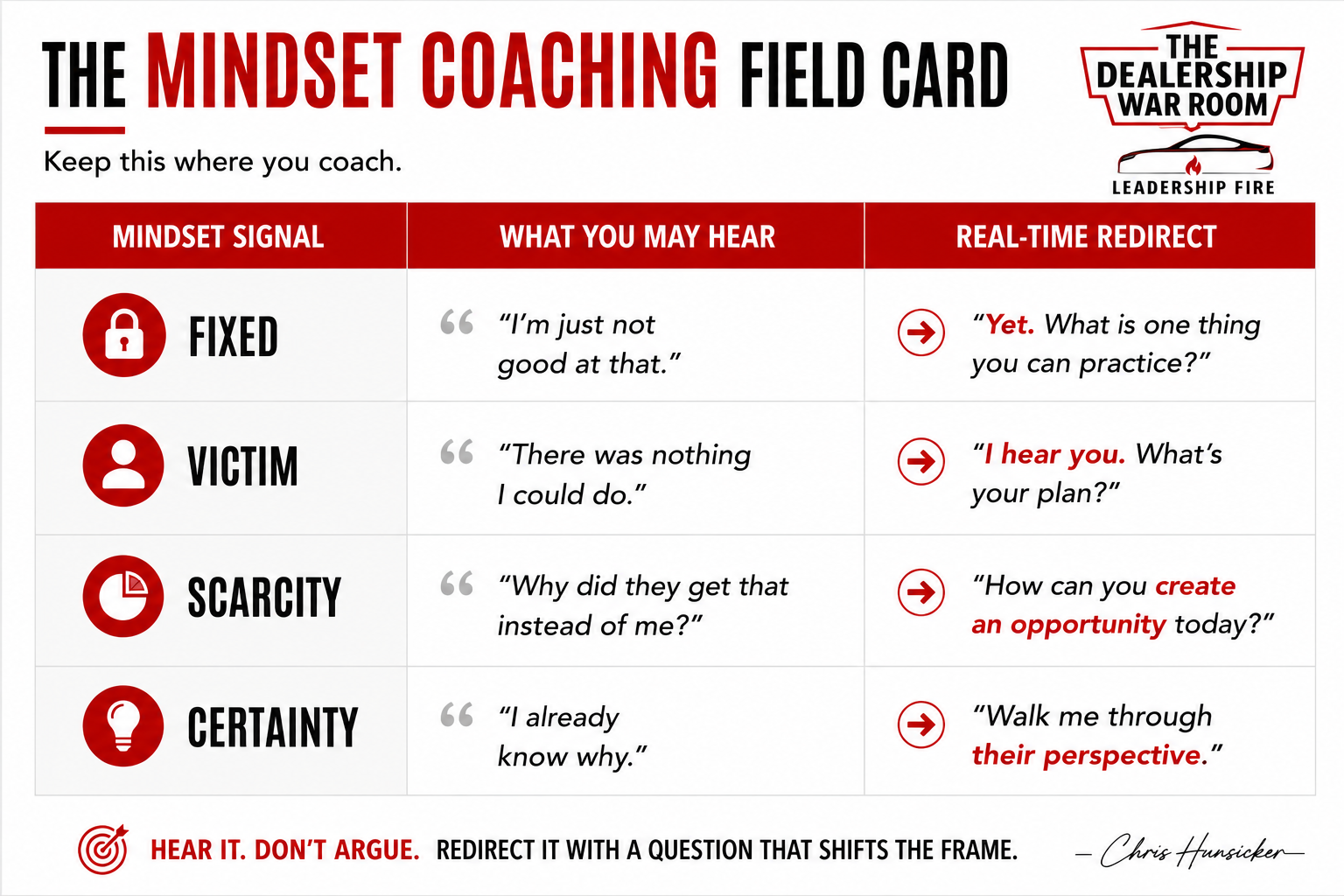
The Real-Time Pattern: Hear It, Do Not Fight It, Ask the Next Question
You do not need a scheduled one-on-one every time mindset appears.
You need an ear for the language and a disciplined response.
The pattern is simple:
1. Hear the frame.
2. Resist the urge to argue, lecture, rescue, or label.
3. Ask a question that points toward growth, ownership, creation, or perspective.
Fixed: “I’m not good at that.” “Yet. What is one thing you can practice this week?”
Victim: “There was nothing I could do.” “I hear you. What’s your plan now?”
Scarcity: “Why did they get that opportunity?” “How can you create an opportunity today?”
Certainty: “I already know why.” “Walk me through the customer’s perspective.”
Fifteen seconds.
One question.
A different next move.
That is mindset coaching at the speed of dealership leadership.
Five Common Mistakes That Keep the Old Mindset Alive
1. Giving a mindset lecture
The employee does not need a definition of growth mindset in the service lane. They need a question that helps them think differently about the next customer.
2. Correcting limiting language in public
Public correction can turn a coaching moment into a status fight. Use team meetings to teach shared standards. Use private moments for specific redirects unless the language is actively contaminating the room and must be interrupted.
3. Rescuing every complaint
When every problem ends with the manager providing the plan, the team becomes more dependent on the manager, not more accountable.
4. Praising only the star and the final number
What gets recognized gets repeated. When you recognize only the close, the gross, the hours, or the top spot, you miss the preparation, assist, experimentation, and follow-up behaviors that make results repeatable.
5. Asking employees to think abundantly inside a scarcity machine
No coaching question can fully overcome an unfair rotation, unclear lead process, misaligned pay plan, or recognition system that creates one winner and a room full of invisible contributors.
Coach the person.
Audit the system.
Do both.
A Five-Day Mindset Coaching Implementation Plan
Day 1: Listen without fixing
Carry a note card. Record the exact phrases you hear that signal fixed thinking, victimhood, scarcity, or certainty. Capture the person and context. Do not diagnose the employee. Diagnose the moment.
Day 2: Find the repeated pattern
Which mindset appears most often? Where does it show up—morning meetings, service-lane coaching, lost-deal reviews, lead assignments, KPI reviews, or manager-to-manager conversations?
Day 3: Choose one redirect
Do not attempt to install four new coaching habits at once. Pick the phrase you hear most and practice the matching question until it becomes natural.
Day 4: Inspect one system
Review one mechanism that may be reinforcing the mindset: recognition, rotation, meeting language, comp-plan messaging, onboarding, coaching cadence, or who receives development opportunities.
Day 5: Celebrate one shift
Recognize a person who took ownership, tried a new approach, helped a teammate, or admitted they did not know. Be specific about the behavior and why it matters. Then repeat the cycle next week.
Five-question manager scorecard
Score each item 0 for rarely, 1 for inconsistently, or 2 for consistently.
1. I listen for the belief or frame beneath the employee’s words.
2. I ask before I tell.
3. I validate real conditions without removing accountability.
4. I recognize process, ownership, assists, and reflection—not only outcomes.
5. I inspect whether our systems reinforce the mindset I say I want.
A score below 7 is not a verdict. It is data. And data gives you somewhere to start.
Frequently Asked Questions
Can a short question really change an employee’s mindset?
One question is not a permanent transformation. It is a pattern interrupt. Repeated questions, clear expectations, useful feedback, and aligned systems make the new frame more likely to become the employee’s own habit of thinking.
What if the external condition really was the problem?
Acknowledge it. Ownership is not denial. The coaching question is still useful: “Given that reality, what can we control next?”
Does abundance mean everybody gets the same outcome?
No. Abundance means people do not need to sabotage, hoard, or hide information to succeed. Individual performance still matters. The culture also recognizes the actions that increase the team’s capacity.
What if an experienced employee refuses to be curious?
Lead with curiosity yourself, ask for their perspective, and reward honest reflection. If they repeatedly reject feedback or required process, move from coaching to clear accountability. Curiosity is an opening, not an escape from standards.
Which mindset should a dealership leader address first?
Start with the language you hear most often and the pattern doing the most damage. In one store that may be excuse-making. In another it may be lead scarcity. In another it may be a veteran employee whose certainty blocks every coaching conversation.
Coach the Thinking Beneath the Doing
The ceiling is not always in the KPI.
Sometimes it is in the sentence spoken right after the KPI misses.
“I’m not good at that.”
“There was nothing I could do.”
“They got what should have been mine.”
“I already know.”
Elite leaders hear those sentences differently.
They add “yet.”
They validate, then ask for the plan.
They celebrate the assist and inspect the system.
They ask for the employee’s perspective before delivering their own.
They do not only manage behavior
They coach the thinking beneath it.
Episodes 356 through 360 of The Dealership War Room give leaders a complete mindset-coaching arc.
Use the field card. Practice one redirect. Listen to what changes in the next conversation.
Then build the skill until the question becomes instinct.
Want to hear Chris break down each step? Watch Episodes 356 –360 and subscribe to The Dealership War Room on YouTube.
Watch it here: Chris Hunsicker | The Dealership War Room


