
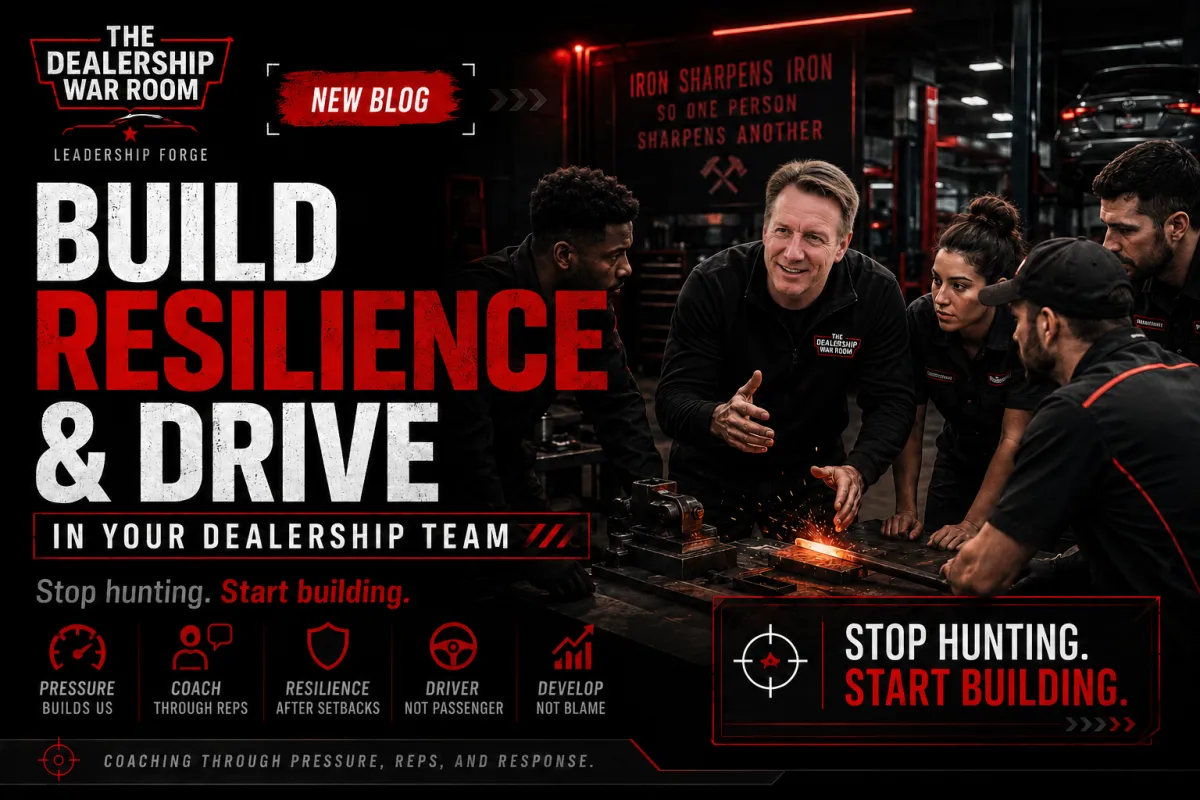
Build Resilience and Drive in Your Dealership Team
Stop Looking for Better People: Build Resilience and Drive Into the Team You Already Have
The lot is empty.
The board is still glowing red.
Everybody else went home an hour ago, and you are sitting behind your desk doing the math.
How many deals died?
How many repair orders should have been saved?
How many follow-up calls never happened?
How much longer can you carry the whole operation before something in you gives out?
Then the sentence shows up.
“If I could just find better people.”
It sounds reasonable.
It may also be the most expensive belief in your dealership.
Because the moment you decide your people either arrived with drive or they did not, development stops. Coaching becomes correction. Accountability becomes frustration. Every setback becomes more proof that you hired the wrong person.
You keep hunting for finished people.
And you keep carrying the store while you wait for them.
Across Dealership War Room Episodes 371 through 375, we attacked that belief from five different directions. The conclusion is simple:
What looks like a talent shortage may actually be a development gap.
Resilience can be developed.
Self-efficacy can be developed.
A stronger response to pressure can be practiced.
But none of it is built through a speech.
It is built through reps.
Your Employees May Be Unforged, Not Unmotivated
Many dealership leaders grew up getting developmental reps they never recognized as training.
A demanding first job.
A coach who would not let them quit.
Chores with consequences.
A difficult season they had to work through.
A customer who did not care whether they were having a bad day.
Nobody called it leadership development. Life simply kept putting weight on the bar.
Today, some employees arrive at the dealership without the same stack of experiences. They may have ability. They may care. They may even want to perform.
But they have not learned what to do when the customer says no, the appointment does not show, the repair goes sideways, or the month starts badly.
The wrong conclusion is:
“This person is lazy.”
The more useful first question is:
“Which capability has not been built yet?”
That question does not eliminate accountability.
It makes accountability more precise.
You can hold someone responsible for the standard while also teaching them how to meet it. That is empathy with accountability. Not lowering the bar. Not excusing weak behavior. Building the capability required to clear it.
Five capabilities shape this work:
Resilience: recovering after the hit.
Self-efficacy: believing your actions can influence the result.
Grit: staying in the fight after the excitement disappears.
A servant’s heart: finding dignity in meeting another person’s need.
Emotional stamina: doing the next necessary task even when you do not feel like doing it.
The first two—resilience and self-efficacy—change how a dealership employee responds to almost everything else.
Resilience Is Not a Personality Type
Picture a salesperson losing a deal they were certain was done.
The customer leaves.
The salesperson drops into the chair, stares at the CRM, and starts explaining why the opportunity was never real.
Bad lead.
Wrong vehicle.
Payment shopper.
Internet department set it badly.
Manager took too long.
That lost deal matters.
But the greater cost may be what happens next.
The salesperson carries the loss into the next customer. They stop asking the next question. They shorten the walk-around. They assume the objection cannot be overcome. They make half the follow-up calls they normally make.
It is rarely the first hit that destroys the week.
It is the collection of weak responses after the hit.
That is why resilience is not a soft topic. It affects your forecast, your close rate, your customer experience, and the emotional stability of the entire department.
Research also challenges the idea that resilience belongs only to a rare group of unusually tough people. In a review discussed by psychologist George Bonanno, 67 analyses of outcomes after potentially traumatic events showed that, on average, about two-thirds of participants followed a resilient trajectory. The research does not mean every person automatically handles every setback well. It does challenge the belief that recovery is an abnormal exception.
In the dealership, resilience begins with one question swap.
Instead of:
“Why is this happening to me?”
Ask:
“What is this asking of me?”
The event did not change.
The door you opened did.
The first question sends the employee searching for blame.
The second sends them searching for a response.
Build the Response in Yourself First
Before you teach that question to your team, listen to the lesson your own reactions are already teaching.
What happens when your top closer quits?
What happens when the Saturday numbers crater?
What happens when the advisor with the strongest CSI gets pulled into another customer complaint?
Your employees study your face before they listen to your words.
If you explode, they learn that pressure makes leaders lose control.
If you disappear into your office, they learn that bad news is something to hide from.
If you blame the market in the morning meeting, do not act surprised when the floor blames the leads that afternoon.
In Episode 373, I told the story of sitting on a bench in Germany at nineteen years old.
My work permit had been denied. I had almost no money. My return ticket was useless. When I called home, my father told me they could not help.
I had two choices.
I could decide my life had collapsed.
Or I could decide I had a problem, problems have solutions, and I was the person responsible for finding one.
That decision did not feel heroic.
It was quiet.
But it gave me evidence I have carried through every difficult season since:
When the floor falls out, I do not.
One tool for making that decision is E + R = O:
Event + Response = Outcome.
The formula is not mine. Jack Canfield has used it to explain personal responsibility, and Tim Kight’s work made it a central operating principle for leaders and teams.
The event matters.
You just do not get to control all of it.
The customer can leave.
The employee can resign.
The manufacturer can change the program.
The month can start badly.
Your response is the variable you still own.
Before reacting, run the event through three filters:
Is it temporary?
One lost deal is not proof you can no longer close.
One bad survey is not proof the department has collapsed.
Is it contained?
A difficult hour does not have to become a ruined day.
A missed target in one category does not automatically define the entire operation.
Is it a verdict on me?
There may be something you need to fix.
That is different from deciding the event proves you are broken, incapable, or finished.
Temporary.
Contained.
Not your identity.
That is the frame your team needs to see you model.
You Cannot Lecture Resilience Into Someone
Once you can manage your own response, take the rep to your team.
Start with the next real setback.
Do not wait for a workshop.
Do not build a twelve-slide training deck.
Use the next lost deal, declined repair, missed appointment, difficult customer, or blown follow-up.
The employee is probably expecting the normal post-mortem:
“What happened?”
“Whose fault was it?”
“Why didn’t you do what I told you?”
Try a different question:
“That one is gone. What is it asking of us on the next opportunity?”
The first time, the employee may not know how to answer.
That is normal.
The question is still yours.
Run it again after the next setback.
Then again.
Eventually, the employee begins asking it before you arrive.
That is the moment the frame starts becoming theirs.
Two leadership behaviors make the rep stick.
1. Say your own response out loud
“We lost the largest deal on the board. That hurts. Here is what I think it is asking us to improve.”
Do not pretend the setback does not matter.
Show the team how a steady leader processes something that matters.
2. Name the real recovery when you see it
“You lost that deal yesterday, and you were fully engaged with the next customer this morning. That recovery is what good looks like.”
Be specific.
Do not say, “Great attitude.”
Tell them what they actually did.
That gives the employee a behavior they can repeat.
Hypothetical service example: An advisor mishandles a difficult conversation about a delayed repair. Instead of letting the advisor spend the afternoon complaining about the customer, the service manager asks, “What is this asking us to do differently on the next status call?” The manager then listens for the next complete, proactive update and names it when it happens.
That is not mood management.
That is a developmental rep.
Self-Efficacy Separates Drivers From Passengers
Resilience helps someone recover after the hit.
Self-efficacy helps them believe the next action is worth taking.
Psychologist Albert Bandura used self-efficacy to describe beliefs about a person’s ability to organize and execute the actions needed to produce an outcome. Those beliefs influence motivation, persistence, and behavior.
On a dealership floor, the difference is easy to see.
A driver loses a deal and asks:
“What can I still do?”
A passenger loses a deal and asks:
“What can I blame?”
The driver believes the extra call, better question, cleaner presentation, or stronger follow-up can influence the outcome.
The passenger believes the outcome was already decided by the lead source, the price, the market, the inventory, or the customer.
That passenger may not be lazy.
From their point of view, withholding effort is rational. Why spend energy on an action you do not believe changes anything?
This is also why self-efficacy is not the same as self-esteem.
Self-esteem is a broad judgment about personal worth.
Self-efficacy is specific:
“I can handle this customer.”
“I can make this call.”
“I can recover this repair order.”
“I can improve this process.”
Your dealership does not need hollow praise. It needs credible evidence.
Do not tell a struggling employee they are great when both of you know the work was poor.
Catch the true things.
“You asked for the appointment instead of ending the call.”
“You stayed with that objection.”
“You made every follow-up before leaving.”
“You brought the problem to me before the customer had to.”
Real win.
Honestly named.
Repeated over time.
That is how the employee begins connecting their action to the result.
There is still a point where the issue may be role fit. A person may lack a required skill, refuse coaching, or repeatedly fail to meet the standard.
But do not make that your first conclusion.
Build the stack of evidence before you make the call.
Five Mistakes That Keep Teams Weak
Mistake 1: Labeling before diagnosing
“Lazy,” “soft,” and “not hungry” may describe what you see. They do not tell you what to coach.
Mistake 2: Giving speeches instead of reps
A powerful Monday meeting cannot replace five deliberate coaching moments during the week.
Mistake 3: Praising what did not happen
Credibility matters. False praise teaches the employee to distrust the leader.
Mistake 4: Teaching panic through your own reactions
Your team will copy what you model under pressure, not what you wrote in the handbook.
Mistake 5: Confusing development with indefinite tolerance
Development requires standards, observation, feedback, practice, and a timeline. It is not permission to underperform forever.
A Seven-Day Dealership Implementation Plan
Day 1: Run the Driver-Passenger Audit
Write every employee’s name.
Mark each one D or P based on the behavior they show when something goes wrong.
Do they reach for an action?
Or do they reach for blame?
Put your own name at the bottom.
Day 2: Choose one person
Do not try to transform the whole dealership at once.
Choose the employee whose ability is stronger than their current response pattern.
Day 3: Identify the predictable setback
Lost appointments?
Price objections?
Difficult service customers?
Missed follow-up?
Know where the next rep is likely to appear.
Day 4: Model your own response
When something goes wrong, pause before speaking.
Ask yourself:
“What is this asking of me?”
Then say the useful part of your answer out loud.
Day 5: Run the question with the employee
“What is this asking of us on the next opportunity?”
Do not answer immediately. Make them think.
Day 6: Catch credible evidence
Look for one real example of a stronger response and name the exact behavior.
Day 7: Review the pattern
Did the employee move toward action faster?
Did you remain steadier?
What rep needs to be repeated next week?
The Five-Minute Forge Review
Use this after any meaningful setback:
Event: What happened, without exaggeration?
Response: What did I or the employee do next?
Frame: Are we treating this as temporary, contained, and specific?
Question: What is this asking of us?
Rep: What behavior should we practice on the next opportunity?
Evidence: What real improvement will I watch for and name?
Ownership: Are we reaching for an action or reaching for blame?
Fit: Is this still a development issue, or is there credible evidence of a role-fit problem?
Print it.
Put it in the manager’s office.
Use it in the sales tower, the service lane, the BDC, and the morning huddle.
The value is not in reading it.
The value is in running it until the questions become automatic.
Frequently Asked Questions
Does this mean every employee can become a top performer?
No. Development does not erase differences in ability, judgment, work ethic, or fit. It gives leaders a more accurate process for distinguishing a capability gap from a role-fit problem.
How long does building resilience take?
There is no honest universal timeline. Look for behavioral evidence: faster recovery, less blame, stronger next actions, and more independent use of the coaching question.
Is asking “What is this asking of us?” too soft?
Not when it is followed by a specific behavior and a clear standard. The question moves the conversation away from rumination and toward execution.
What should I do with an employee who refuses the rep?
Clarify the expectation, explain the behavior required, provide the opportunity to practice, and document what happens. Empathy and accountability belong in the same conversation.
Stop Hunting. Start Building.
The leader looking for finished people will keep looking forever.
The leader who decides to build people can begin with the next setback.
Not next quarter.
Not after the next hire.
The next lost deal.
The next difficult customer.
The next number that misses.
Control your response.
Ask the better question.
Run the rep.
Name the evidence.
Then do it again.
Because the forge may have gone cold in a lot of places.
But it is still lit where you work.
Ready to build drive, grit, and resilience into the team you already have? Pre-register for Forged, Not Found and receive the free chapter.
For the complete teaching behind this article, watch or share Dealership War Room Episodes 371 through 375.


